No Equipment? No Problem! The Ultimate Home Kit for Recovery and Physical Rehabilitation
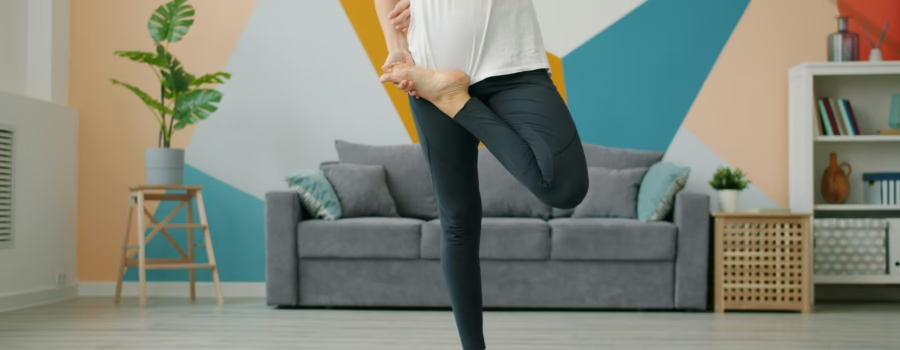
Think you need expensive equipment for physiotherapy at home? Think again. Your kitchen and living room already have everything you need. Rice bags become dumbbells. Towels replace resistance bands. Sofa cushions work as balance trainers. Learn how to build your no-cost home recovery toolkit with items you already own.
“How can I do my exercises at home without physiotherapy equipment?”
This is one of the most common questions patients ask. And here’s the honest answer:
The most effective piece of equipment is your own body.
Rehabilitation isn’t about fancy tools. It’s about principles: safe movement, controlled resistance, and consistency. Many household items can perfectly replicate the function of expensive clinic equipment, helping you achieve remarkable results without the cost.
Let’s build your no-cost home recovery toolkit
Understanding the Principles Behind Home Exercises
Before diving into household substitutes, it’s essential to understand why these work. Three core principles drive effective rehabilitation:
1. Progressive Overload
Exercise prescription relies on targeting specific mechanical and neurological goals, not the equipment itself. Whether the resistance comes from a dumbbell or a bag of flour, the effect on your muscles is the same.
What matters is gradually increasing the challenge over time, not the price tag of your equipment.
2. Activation of Stabilizers
Exercises that require you to maintain tension (like pulling a resistance band) are highly effective for engaging deep core and stabilizing muscles.
A simple bath towel, pulled tautly between your hands, can replicate this tension. This forces your rotator cuff and upper back muscles to work harder, promoting joint stability. It works exactly like an expensive resistance band would.
3. Proprioception and Balance
Improving balance relies on challenging your body’s ability to sense its position in space (proprioception). You don’t need a fancy wobble board.
Standing on an unstable surface, like a firm pillow or couch cushion, forces the tiny muscles around your ankles, knees, and hips to fire rapidly. This mimics the challenge of high-end balance equipment at zero cost.
Your Home Physiotherapy Toolkit: Household Substitutes from an Indian Home
Here’s how to use common household items effectively to achieve the three pillars of recovery: resistance, stability, and mobility.
1. Resistance (Your Weight Room
| Household Substitute | Approximate Weight | Why It Works (Clinic Equivalent) |
|---|---|---|
| Sealed 1 kg packet of Rice/Dal/Flour | ~1 kg | Perfect, measurable weights for isolated movements like arm raises or rotator cuff exercises. Equivalent to a light Cuff Weight or Dumbbell. |
| 1-Litre Water Bottle (filled) | ~1 kg | Easy-to-grip alternative for gentle strengthening exercises like wrist curls or small shoulder movements. Equivalent to a light Dumbbell. |
| 5 kg Rice/Atta Bag | ~5 kg | Excellent for adding significant load to compound exercises like squats or lunges when held securely. Equivalent to a light Barbell or Sandbag. |
| Sturdy Backpack filled with books | Variable (easily measured) | Worn during squats or step-ups, this provides balanced, adjustable resistance to load your hips and knees safely. Equivalent to a Weight Vest. |
Pro tip: Start with lighter weights and progress gradually. Your body adapts best when challenged progressively.
2. Mobility & Stretching (Your Strap & Slider)
| Household Substitute | How to Use | Why It Works (Clinic Equivalent) |
|---|---|---|
| Long Cotton Towel or Sturdy Dupatta | Loop it around your foot or hand to gently pull and deepen stretches (hamstring, calf stretches). | Provides controlled leverage without bending or straining. Equivalent to a Yoga Strap or Stretch Out Strap. |
| Bath Towel (Pulled Taut) | Pull the towel apart forcefully during rows, chest presses, or internal/external rotation. | Activates deeper stabilizer muscles in the back and shoulder blades. Equivalent to a Resistance Band. |
| Old Socks or Small Hand Towels | Place under your feet or hands on tile or marble floors. | Creates a low-friction surface, forcing core muscles to stabilize as you slide. Equivalent to Gliders/Sliding Discs. |
3. Stability, Balance & Release (Your Proprioception Lab)
| Household Substitute | How to Use | Why It Works (Clinic Equivalent) |
|---|---|---|
| Firm Pillow or Sofa Cushion | Stand on it on one leg or perform partial squats. | Creates an unstable surface, forcing the small stabilizing muscles around your joints (ankles, knees, hips) to work harder. Equivalent to a Balance Pad or Wobble Board. |
| Flight of Stairs (with Railing) | Use the steps for calf raises, step-ups, and step-downs. | Provides a safe, standardized height for loading and strengthening leg muscles during functional movements. Equivalent to a Plyo Box. |
| Sturdy Chair (against a wall) | Use for supported sit-to-stand exercises, seated marches, or triceps dips. | Offers a stable base for support and height adjustment. Especially helpful for elderly patients. Equivalent to a Treatment Table. |
Safety Tips for Home Exercise
Before starting your home rehabilitation program, keep these essentials in mind:
- Clear your workout space: Remove obstacles that could cause falls
- Use stable furniture: Always brace chairs or benches against a wall
- Start slow: Begin with lighter resistance and fewer repetitions
- Listen to your body: Mild discomfort is normal; sharp pain is not
- Stay consistent: Regular practice beats occasional intense sessions
Key Takeaway
Safety and consistency are the keys to successful recovery.
With these simple household tools, you can receive safe, effective, and personalized care without the cost and hassle of expensive equipment. Your home already has everything you need to start healing.
Ready to Get Expert Guidance?
While household items work wonderfully for many exercises, having a physiotherapist create a personalized program ensures you’re doing the right exercises for your condition.
Our experts can assess your needs online and design a home recovery plan that uses exactly what you have available.